

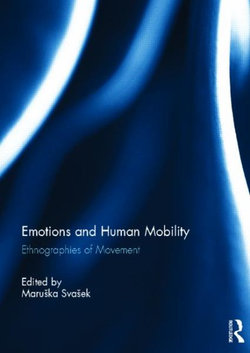


This book provides insights into the emotional dimensions of human mobility. Eight ethnographic case studies deal with issues as varied as the fear, contempt and empathy felt by immigration officers in a British Immigration Removal Centre, the ambiguous feelings of Japanese wives living in Ireland, and the hope and disappointment of Australia-based Hungarians after the ending of State Socialism in Hungary. Drawing on findings and theoretical discussions in anthropology, sociology, cultural studies, philosophy, linguistics, migration studies, human geography and political science, the contributors offer interdisciplinary perspectives on a highly topical debate, asking how 'emotions' can be conceptualised as a tool to explore human mobility. The authors investigate how emotional processes are shaped by migration, and vice versa. To what extent are people's feelings about migration influenced by structural possibilities and constraints, for example by immigration policies or economic inequality? How do migrants interact emotionally with the people they meet in the receiving countries, and how do they attach to new surroundings?
How do they interact with 'the locals', with migrants from other countries, and with migrants from their own homeland? How do they stay in touch with absent kin? The volume zooms in on specific cases of migration within Europe (for example Poles to Britain), of intercontinental mobility (for example from Europe and Asia to Australia), and of diasporic dynamics (for example Tibetan refugees in India). In the introduction, the editor proposes a framework that includes several interlinked conceptual dimensions, defining emotions as discourses, practices and embodied experiences. Critically engaging with the affective turn in the study of migration, the chapters are highly relevant to scholars involved in current theoretical debates on human mobility. Providing grounded case studies that show how theory arises from concrete historical cases, the book is also highly accessible to students and can be used as an introductory text in courses on globalisation, migration, transnationalism and emotions. This book was originally published as a special issue of Journal of Ethnic and Migration Studies
How do they interact with 'the locals', with migrants from other countries, and with migrants from their own homeland? How do they stay in touch with absent kin? The volume zooms in on specific cases of migration within Europe (for example Poles to Britain), of intercontinental mobility (for example from Europe and Asia to Australia), and of diasporic dynamics (for example Tibetan refugees in India). In the introduction, the editor proposes a framework that includes several interlinked conceptual dimensions, defining emotions as discourses, practices and embodied experiences. Critically engaging with the affective turn in the study of migration, the chapters are highly relevant to scholars involved in current theoretical debates on human mobility. Providing grounded case studies that show how theory arises from concrete historical cases, the book is also highly accessible to students and can be used as an introductory text in courses on globalisation, migration, transnationalism and emotions. This book was originally published as a special issue of Journal of Ethnic and Migration Studies



Share This Book: