

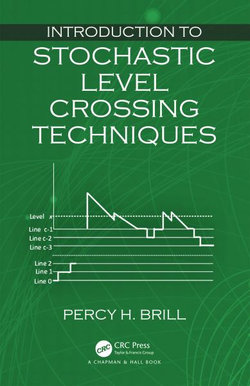


Introduction to Stochastic Level Crossing Techniques describes stochastic models and their analysis using the System Point Level Crossing method (abbreviated SPLC or LC). This involves deriving probability density functions (pdfs) or cumulative probability distribution functions (cdfs) of key random variables, applying simple level-crossing limit theorems developed by the author. The pdfs and/or cdfs are used to specify operational characteristics about the stochastic model of interest. The chapters describe distinct stochastic models and associated key random variables in the models. For each model, a figure of a typical sample path (realization, i.e., tracing over time) of the key random variable is displayed. For each model, an analytic (Volterra) integral equation for the stationary pdf of the key random variable is created by inspection of the sample path, using the simple LC limit theorems. This LC method bypasses a great deal of algebra, usually required by other methods of analysis. The integral equations will be solved directly, or computationally. This book is meant for students of mathematics, management science, engineering, natural sciences, and researchers who use applied probability. It will also be useful to technical workers in a range of professions.
Key Features:
A description of one representative stochastic model (e.g., a single-server M/G/1 queue; a multiple server M/M/c queue; an inventory system; etc.)
Construction of a typical sample path of the key random variable of interest (e.g., the virtual waiting time or workload in queues; the net on-hand inventory in inventory systems; etc.)
Statements of the simple LC theorems, which connect the sample-path upcrossing and downcrossing rates across state-space levels, to simple mathematical functions of the stationary pdf of the key random variable, at those state-space levels
Creation of (usually Volterra) integral equations for the stationary pdf of the key random variable, by inspection of the sample path
Direct analytic solution of the integral equations, where feasible; or, computational solutions of the integral equations
Use of the derived stationary pdfs for obtaining operational characteristics of the model
Key Features:
A description of one representative stochastic model (e.g., a single-server M/G/1 queue; a multiple server M/M/c queue; an inventory system; etc.)
Construction of a typical sample path of the key random variable of interest (e.g., the virtual waiting time or workload in queues; the net on-hand inventory in inventory systems; etc.)
Statements of the simple LC theorems, which connect the sample-path upcrossing and downcrossing rates across state-space levels, to simple mathematical functions of the stationary pdf of the key random variable, at those state-space levels
Creation of (usually Volterra) integral equations for the stationary pdf of the key random variable, by inspection of the sample path
Direct analytic solution of the integral equations, where feasible; or, computational solutions of the integral equations
Use of the derived stationary pdfs for obtaining operational characteristics of the model



Share This Book: