Free shipping on orders over $99
The Dyehouse

The Dyehouse 1

Text Classics

by Mena Calthorpe
Paperback
Publication Date: 29/08/2016
4/5 Rating 1 Review

Share This Book:

RRP  $14.95

RRP means 'Recommended Retail Price' and is the price our supplier recommends to retailers that the product be offered for sale. It does not necessarily mean the product has been offered or sold at the RRP by us or anyone else.

$14.75
or 4 easy payments of $3.69 with
afterpay

This powerful and affecting novel was first published in 1961, and is the hundredth book in the Text Classics series.

The new edition comes with an introduction by Fiona McFarlane, acclaimed author of The Night Guest. Written with unerring skill and insight, The Dyehouse is a masterly portrait of postwar Australia,when industrial work was radically transformed by new technologies and society changed with it.

Mena Calthorpe who herself worked in a textile factory takes us inside this world, vividly bringing to life the people of an inner-Sydney company in the mid-1950s: the bosses, middlemen and underlings; their dramatic struggles and their loves.

ISBN:
9781925355758
9781925355758
Category:
Contemporary fiction
Format:
Paperback
Publication Date:
29-08-2016
Publisher:
The Text Publishing Company
Country of origin:
Australia
Pages:
304
Dimensions (mm):
197x130mm
Weight:
0.23kg
Mena Calthorpe

Mena Calthorpe was born in Goulburn, New South Wales, in 1905, and grew up there. After marrying, Calthorpe moved to Sydney and lived for most of her life in the Sutherland Shire.

Working in office jobs and writing in her spare time, she was active in literary groups and in the Labor Party for some years she was a member of the Communist Party, and she opposed B. A. Santamaria’s attempts to stop communism in trade unions.

The Dyehouse (1961) was followed by The Defectors (1969), which dramatised unions’ internal power struggles. Mena Calthorpe’s third and final novel was The Plain of Ala, an Irish migrant story, which was published in 1989. She died in 1996.

This title is in stock with our Australian supplier and should arrive at our Sydney warehouse within 1 week of you placing an order.

Once received into our warehouse we will despatch it to you with a Shipping Notification which includes online tracking.

Please check the estimated delivery times below for your region, for after your order is despatched from our warehouse:

ACT Metro: 2 working days
NSW Metro: 2 working days
NSW Rural: 2-3 working days
NSW Remote: 2-5 working days
NT Metro: 3-6 working days
NT Remote: 4-10 working days
QLD Metro: 2-4 working days
QLD Rural: 2-5 working days
QLD Remote: 2-7 working days
SA Metro: 2-5 working days
SA Rural: 3-6 working days
SA Remote: 3-7 working days
TAS Metro: 3-6 working days
TAS Rural: 3-6 working days
VIC Metro: 2-3 working days
VIC Rural: 2-4 working days
VIC Remote: 2-5 working days
WA Metro: 3-6 working days
WA Rural: 4-8 working days
WA Remote: 4-12 working days


Reviews

4.0

Based on 1 review

5 Star
(0)
4 Star
(1)
3 Star
(0)
2 Star
(0)
1 Star
(0)

1 Review

“There was something disturbing about his expressionless face. The fair, straight hair, the shrill eyes, the droop of the mouth. He picked up a pen and began doodling. A circle. Then another and another. And suddenly the eyes, withdrawn, opened wide. The dead mask of the face was swept away. The smile was sudden and electric”

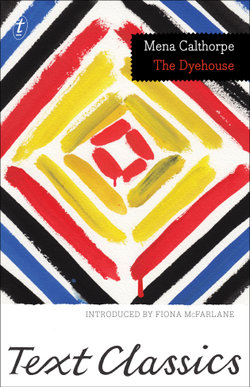
The Dyehouse is the first of only three novels ever written by Australian author, Mena (Philomena) Calthorpe. It was first published in 1961, and this Text Classics edition (which is their 100th Text Classics book) sports a gorgeous colourful cover by the talented W H Chong, and an introduction by Fiona McFarlane.

It is set in post-war Sydney, a supposedly fictitious suburb called Macdonaldtown, the site of many factories including the dyehouse of the Southern Textiles Dye Works. It takes intimate dips into the lives of the employees: the office ladies, the manager, the pressers, the Company Secretary, the head dyer, the General Manager, the engineer, the Chairman of Directors, the setters.

Competition and changes wrought by the introduction of nylon and the difficulty it presents to dyers underlie the dramas in the lives of the dyehouse employees: a late-in life pregnancy, a seduction, unrequited love, poverty, the threat of unemployment. Calthorpe highlights the management’s “us and them” mindset.

Poor working conditions, compete and callous disregard by management of employee loyalty, experience and expertise, management’s lack of compassion, sexual harassment, all fuel the imminent industrial action that is hinted at but does not yet happen. Calthorpe’s personal experience working in a textile factory is apparent on every page.

Calthorpe describes a time when ladies always wore hats and gloves and stockings, when all records were written by hand, when a telephone call was almost an event, when few owned cars and most walked or took public transport, when calculations were done by adding machine. This will undoubtedly resonate with readers of a certain vintage

Her descriptive prose is economical and evocative: “To the south of the sandy waste a row of dilapidated houses with broken windows looked out to the sea. In these shambles human beings lived. They went to work. They were known in factory and mill. They helped create beauty and colour that found no echo in their own lives” This is an impressive debut that was unquestionably topical when it was first published fifty-five years ago.

Contains Spoilers No
Report Abuse